
On this page
- The family tree, and the five Nissan codes behind three JATCO families
- The six numbers that separate them
- 30 mm versus 28 mm
- 901089 versus 901074
- Where the stepper motor went, and why your scan tool notices
- Two JF016E gearboxes are not always the same gearbox
- The three traps that look like a fit
- Fluid, capacity and service interval
- So which one should you be buying?
- Sources and frequently asked questions
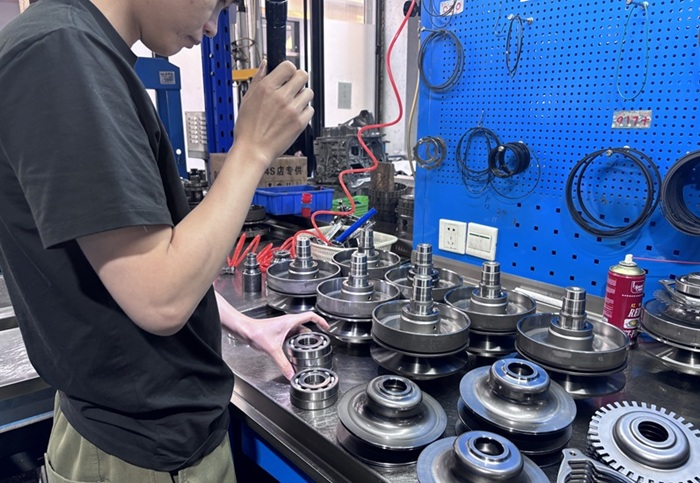
Quick answer. JF011E (RE0F10A) is the previous generation: 250 Nm, a 30 mm pushbelt, a stepper motor in the valve body and roughly 6.1:1 ratio coverage. JF016E (RE0F10D) is the belt CVT8: same 250 Nm class, but a narrower 28 mm belt, no stepper motor, 8 solenoids and about 7:1 coverage. JF017E (RE0F10E/G/H/J) is the chain CVT8: 380 Nm, a LuK pull chain, built for V6 and diesel duty. None of the three interchanges as a complete unit, and even two JF016E gearboxes can differ in final drive and overall length. The transmission code narrows the family; only the assembly number and the label settle the unit.
The question we get most often is not “what is a JF016E” — it is “can I put this one in instead?” Usually the crate is already on the bench, or the listing is already paid for. So this article is organized around the three ways buyers get it wrong: ordering a JF011E believing it is a JF016E, ordering a JF017E believing it is a stronger JF016E, and ordering a JF016E that turns out to be the wrong JF016E.
It is the fifth piece in our JF016E cluster, after the technical guide, the applications chart, the fault-code guide and the OE number reference. It also corrects one claim in that last article, which we will come to in section 04 — the belt story is messier than the marketplace listings suggest.
01The family tree, and the five Nissan codes behind three JATCO families
JATCO builds CVTs in numbered platforms, and Nissan renames each one for its own service literature. Getting the mapping straight removes most of the confusion before any specification is compared:
| JATCO family | Nissan code(s) | JATCO platform | Power-transfer element | Torque class |
|---|---|---|---|---|
| JF011E | RE0F10A | CVT2 | Steel pushbelt, 30 mm | 250 Nm (184 lb-ft) |
| JF016E | RE0F10D | CVT8 | Steel pushbelt, 28 mm | 250 Nm |
| JF017E | RE0F10E | CVT8 | Pushbelt (rare early build) or LuK pull chain | 300 Nm belt / 380 Nm chain |
| RE0F10G | CVT8 | LuK pull chain | 380 Nm | |
| RE0F10H / RE0F10J | CVT8 | LuK pull chain | 380 Nm |
Two lines in that table deserve a second look. First, JF017E is not one transmission. GearboxList documents two builds of it: a rare Bosch pushbelt version rated to about 300 Nm under code RE0F10E, and the far more common LuK pull-chain version rated to 380 Nm under RE0F10G. GEARS Magazine's platform summary lists the JF017E chain units spread across three Nissan codes — RE0F10E, RE0F10H and RE0F10J — for the 3.5 L Altima, Pathfinder, Maxima, Murano, Quest and Infiniti QX60. So a “JF017E” inquiry can mean a belt unit or a chain unit, and the answer changes the whole fitment decision.
Second, the JF011E and JF016E sit in the same 250 Nm class. That is the single most misleading fact in this comparison: the two share a torque rating, share a belt-type architecture, share most of their application footprint, and are separated by a full platform generation. Anyone reasoning from the spec sheet alone can convince themselves they are the same gearbox in two dress sizes. They are not, and section 04 shows why.
02The six numbers that separate them
| Parameter | JF011E (RE0F10A) | JF016E (RE0F10D) | JF017E (RE0F10E/G/H/J) |
|---|---|---|---|
| Torque class | 250 Nm | 250 Nm | 300 Nm belt build / 380 Nm chain |
| Ratio coverage (published) | ~6.1:1 (GEARS Magazine) | ~7:1 (GEARS Magazine) | ~7:1 listed for the CVT8 platform |
| Ratio endpoints, documented application | 2.349–0.394 (Qashqai 2.0) | 2.631–0.378 | 2.475–0.439 (Pathfinder 3.5) |
| Reverse ratio | 1.750 | Planetary reverse (no separate published ratio in most sources) | 2.310 |
| Ratio control | Stepper motor | 8 solenoids, stepper eliminated | 8 solenoids, stepper eliminated |
| Fluid / capacity | NS-2 or NS-3 (see section 06) / ~8.1 L | NS-3 / ~7.9 L | NS-3 / ~8.2 L |
Now the arithmetic that matters, because it is where a lot of confident-sounding claims fall apart. Take the published ratio endpoints and divide them: 2.349 ÷ 0.394 = 5.96 for the JF011E application above; 2.631 ÷ 0.378 = 6.96 for the JF016E; 2.475 ÷ 0.439 = 5.64 for the JF017E Pathfinder application.
Those three results do not line up neatly with the platform-level “6.1:1 vs 7:1” summary, and that is not an error — it is the point. The GEARS numbers describe the platform; the endpoints describe one vehicle application. A Pathfinder's chain CVT is geared for a 3.5 L V6 and a 5,000 lb SUV, not for maximum ratio spread. So when a listing advertises “7:1 ratio range” for every JF016E, it is quoting platform marketing copy at you. If the ratio spread genuinely determines your decision — a tall final drive for highway cruise, say — you need the application's endpoints and final drive, not the family number.
0330 mm versus 28 mm: the belt change nobody advertises
This is the part of the JF011E-to-JF016E transition that decides most real-world outcomes, and it is almost absent from parts listings.
JATCO went from a 30 mm pushbelt on the JF011E to a 28 mm belt on the JF016E, and the belt element count changed with it — the older 30/10 and 30/12 designs giving way to a 28/12 element layout. A narrower belt carrying the same 250 Nm is a real engineering statement: it means the clamping strategy, the pulley geometry and the friction pair were all re-engineered together. The pulley change is visible on the bench — the JF016E pulley sheaves ride on a stronger slider pin instead of the 6 mm ball bearings used on the JF011E, which were a known axial-translation wear point. The primary pulley shaft diameter also shrank, to give the narrower belt its clearance.
| Detail | JF011E | JF016E |
|---|---|---|
| Belt width | 30 mm | 28 mm |
| Belt element layouts in service | 30/10, 30/12 | 28/12 |
| Sheave axial guide | 6 mm ball bearings (known wear point) | Slider pin |
| Primary pulley shaft | Larger diameter | Smaller diameter for belt clearance |
| Forward clutch drum | 3-disc, small spline hub | 3-disc, small spline hub (carried over — still the torque-limiting part) |
That last row is the one rebuilders should tape to the wall. The forward clutch drum was not upgraded in the move to CVT8. Forum teardown documentation from Juke owners running the JF016E at raised boost is blunt about it: the drum is still a three-disc unit with the smaller spline hub, so the torque ceiling people imagine they have removed by fitting the later gearbox is still there, just moved to a different component.
And yes — because the pulley hardware differs, someone has tried to swap JF016E pulleys into a JF011E to get the stronger belt. The same teardown thread documents why it is not a bolt-in: the later pulley assembly has no provision for a speed-sensor reluctor, so the swap needs custom machining before the transmission will even report speed. Physically possible, functionally incomplete — which is the exact pattern section 05 returns to.
04901089 versus 901074: correcting our own previous article
In our OE part-number reference we flagged a marketplace listing that stacked 901089 alongside 901074 and called the second number unverified. Follow-up research says we were half right, and the half we got wrong matters more.
Both numbers are real JF016E belt numbers, at different ratings. The JF016E transmission typically leaves the factory with the 901089 belt, while 901074 (also sold as D822700) is the higher-rated pushbelt — owner teardown documentation describes it as rated beyond 400 Nm and as the highest-rated pushbelt Bosch produces in that series. So a listing that names both numbers is not necessarily keyword stuffing on that point; it may be describing a standard belt and its upgrade.
| Number | What it is | Practical consequence |
|---|---|---|
901089 | The belt a JF016E normally comes with | Correct for a stock rebuild; the number most fitment charts actually need |
901074 / D822700 | Higher-rated pushbelt, described as rated past 400 Nm | An upgrade path for tuned or heavily loaded units — not what the factory fitted |
901096 | Appears in JF017E chain listings alongside the two belt numbers | Different construction entirely — chain, not belt |
RE0F11A | Nissan code, not a belt number | The genuine keyword-stuffing tell: a transmission code in an OEM-number field |
So the corrected rule is narrower and more useful than the one we published: a listing naming 901089 and 901074 together is probably describing two belt grades; a listing naming a transmission code (RE0F11A, RE0F10E) in the OEM number field is stuffing. We would rather publish the correction than keep a tidier story — and if you are rebuilding a stock JF016E, 901089 is the belt your unit was designed around.
05Where the stepper motor went, and why your scan tool notices
The most consequential change between JF011E and JF016E is not mechanical at all: JATCO deleted the ratio-control stepper motor. On the JF011E, a stepper motor physically moves a control valve to set the baseline pulley position — the classic failure point, and the reason so many JF011E valve body listings still instruct the installer to align the stepper motor arm. On the JF016E, that job moved to a bank of pressure-control solenoids, eight of them, with no stepper motor anywhere in the casting.
| Control element | JF011E | JF016E | Why it matters to a rebuilder |
|---|---|---|---|
| Ratio control actuator | Stepper motor | None — solenoid bank | Instructions referencing stepper alignment describe the wrong transmission |
| Solenoid count in valve body | Fewer circuits, stepper handles ratio | 8 solenoid circuits | Valve body assemblies are not swappable between families |
| Virtual stepped ratios | Not offered | Available on later calibrations (paddle-shift stepped feel, JF017E documented with 8 steps) | Software-era feature; affects calibration matching |
| Relearn / calibration after valve body | Stepper position relearn | Calibration data written from the QR label, then additional service | Two different procedures that look similar in a generic scan tool menu |
This is why the “stepper motor alignment” instruction on a CVT8 valve body listing is such a useful signal. We wrote about it in the fault-code guide as evidence that a supplier was copy-pasting JF011E text; here it has a mechanical explanation. If a seller tells you to align a stepper arm on a JF016E, they have never had one of these castings in their hands, and their fitment advice should be discounted line by line.
06Two JF016E gearboxes are not always the same gearbox
The third way to buy wrong does not involve another family at all. JATCO's own vehicle-specific product introductions document four JF016E applications with the same 250 Nm class and materially different hardware:
| Application | Torque class | Final drive | Overall length |
|---|---|---|---|
| Nissan Rogue | 250 Nm | 5.694 | 362.3 mm |
| Nissan Serena | 250 Nm | 5.385 | 358.8 mm |
| Renault Duster | 250 Nm | 5.694 | 375.2 mm |
| Mitsubishi Destinator | 250 Nm | 6.386 | 372.2 mm |
Read the length column twice. The spread from 358.8 mm to 375.2 mm is 16.4 mm — more than half an inch of case length — inside one transmission family, at one torque rating. The final drive spreads from 5.385 to 6.386, a difference that changes cruise rpm and speedometer calibration, and the Destinator application alone accounts for the top of both ranges.
So the family code describes a core design, not one universal assembly. What the vehicle manufacturer is free to change inside a JF016E envelope, per JATCO's own documentation, includes: final-drive ratio and differential, torque converter specification, 2WD versus 4WD configuration, selector and shift-by-wire arrangement, control valve and hydraulic configuration, casing and mounts, and vehicle-specific software. Any of those can make a physically similar unit wrong for your car.
07The three traps that look like a fit
None of the three crossover attempts below is a fantasy — each one gets far enough to feel plausible, then stops.
Trap one: JF011E into a CVT8 car. The bellhousing pattern is close enough that the unit will bolt up in some applications, the cooler lines can be adapted, and the connector count looks manageable. Then the TCM has no stepper motor to command, the calibration table is for a different ratio spread, and the unit goes into failsafe or slips while the installer chases a wiring fault that does not exist.
Trap two: JF017E as an “upgrade” to a JF016E. This one gets argued most often, because 380 Nm sounds like headroom. It is a different architecture — a LuK pull chain against a Bosch pushbelt — and JATCO's own product documentation treats the two as separate branches developed for different torque and vehicle requirements, not a low and high specification of one gearbox. A JF017E is not a stronger JF016E, and a JF016E is not a cheaper JF017E.
Trap three: the wrong JF016E. No architecture mismatch at all — just a different final drive and 16 mm of case length from the application table above. This is the trap that a model-year check cannot catch, because the year plate does not encode the assembly.
| Trap | What makes it feel plausible | What stops it | How to catch it before shipping |
|---|---|---|---|
| JF011E in place of JF016E | Same 250 Nm class, same belt architecture, shared application footprint | No stepper motor on the CVT8 side; different calibration and relearn procedure | The 31705 prefix: X42/3JX versus 28X |
| JF017E in place of JF016E | 380 Nm reads as “stronger version” | Chain versus belt; separate JATCO product branch; different valve body | Case label code: RE0F10D versus RE0F10E/G/H/J |
| Wrong JF016E | Same code, same torque class, looks identical | Final drive 5.385–6.386; length 358.8–375.2 mm | The 31020 assembly number on the case |
There is an electronic version of the same trap, and Nissan wrote the rule down. Bulletin NTB12-103g requires that the calibration information supplied with a replacement CVT or valve body match the QR label and calibration number on the replacement component, followed by the specified learning procedure. That is the manufacturer saying out loud what rebuilders learn the hard way: a correct complete transmission has to satisfy both the mechanical and the electronic requirement. Matching bolt holes is not evidence of interchange.
08Fluid, capacity and service interval — including a conflict we cannot resolve
| Item | JF011E | JF016E | JF017E |
|---|---|---|---|
| Fluid | NS-2 historically; NS-3 specified for later builds | NS-3 | NS-3 |
| Capacity | ~8.1 L | ~7.9 L | ~8.2 L |
| Service interval listed by parts data | 60,000 km | Follow vehicle schedule (typically shorter than the “lifetime” claim) | 50,000 km |
| Filter | Family-specific internal filter | 31728-28X0A, shared with JF017E and JF018E | Same 31728-28X0A family |
Here is where honesty costs us a clean table. GearboxList lists NS-3 as the recommended fluid for the JF011E. Three separate parts suppliers state NS-2 for the same transmission, and one of them adds an explicit warning that filling a JF011E with NS-3 causes belt slip. Both cannot be right for every build.
The resolution that matches what we see in the workshop is that Nissan moved the JF011E from NS-2 to NS-3 at some point in its long production run, and the two fluid specifications are genuinely not interchangeable in the wrong direction. That makes the fluid question a per-unit question, answered by the dipstick label, the owner's manual for that exact model year, or the fluid specification sticker on the case — never by the family code. If a seller tells you “all JF011E take NS-3” without asking the year, they are guessing. For the JF016E the answer is unambiguous: NS-3, around 7.9 litres, and the P17F0 calibration write described in the fault-code guide after any valve body change.
09So which one should you be buying?
Not “the strongest one.” That instinct is what generates most of the wrong crates we see. The right answer is the least glamorous one: the unit your case number and label specify.
Our own position is deliberately boring on this point. We stock JF016E valve bodies, belts, filters and the shared hard parts, we handle JF011E and JF017E alongside them, and we do not sell a cross-family conversion as an upgrade — because the calibration path and the ratio spread belong to the vehicle, not to the crate. What we will do is confirm the numbers before anything ships: the JF016E/JF017E valve body page lists what is bench-tested and in stock, the JF011E page covers the previous generation, and the JATCO CVT hub maps the whole family to honest IN STOCK / ASK status rather than pretending everything is on the shelf.
Send three things and the question answers itself: the 31020 assembly number stamped on the case, the QR label with its calibration number, and a photo of the transmission label as currently fitted. If the unit has been replaced before, the VIN describes what the car was built with while the label describes what is in it now — and both matter, because you are buying a replacement for the second one.
10Sources and frequently asked questions
Sources: GEARS Magazine platform summary (CVT2 250 Nm / 6.1:1; CVT8 380 Nm class / 7:1; stepper motor elimination; RE0F10E/H/J spread across JF017E); GearboxList specification pages for JF011E, JF016E and JF017E (capacities, service intervals, documented ratio endpoints and application lists); JATCO vehicle-specific product introductions as compiled for the Rogue, Serena, Duster and Destinator final-drive and length table; owner teardown documentation for the belt widths, element layouts, slider pin and forward clutch drum; Nissan Technical Bulletin NTB12-103g for the calibration-matching requirement; Super5 Gearbox's code cross-reference for the JF011E/JF016E/JF017E branch separation. Where sources conflict — the JF011E fluid specification above all — the conflict is stated rather than resolved by preference.
Is RE0F10D the same as JF016E?
They refer to the same family direction: JF016E is JATCO's family code, RE0F10D is the Nissan service code used for selected steel-belt CVT8 applications. Neither code alone identifies a complete assembly, because JF016E applications differ in final drive (5.385 to 6.386) and overall length (358.8 to 375.2 mm).
Can I fit a JF017E in place of a JF016E?
Not as a substitute or an upgrade. JF017E is a separate CVT8 branch — 380 Nm with a LuK pull chain against the JF016E's 250 Nm pushbelt — developed for different torque and vehicle requirements. The code similarity (RE0F10D versus RE0F10E) makes the idea feel reasonable and the hardware makes it wrong.
Are JF011E and JF016E interchangeable since both are 250 Nm?
No. The shared torque class is exactly why people try. The JF016E deleted the stepper motor, moved ratio control to an eight-solenoid bank, narrowed the belt from 30 mm to 28 mm and changed the pulley sheave guidance to a slider pin. Different valve body, different calibration, different relearn procedure.
Which belt does a JF016E actually use?
Most units leave the factory with the 901089 belt. The 901074 (D822700) is the higher-rated pushbelt, described as rated past 400 Nm, and is an upgrade path rather than production fitment. We corrected an earlier article of ours on this point — a listing naming both numbers is describing two belt grades, not stuffing a keyword.
Does the JF011E use NS-2 or NS-3?
Both, depending on build date. GearboxList lists NS-3; several parts suppliers specify NS-2 and warn that NS-3 in an early unit causes belt slip. Nissan moved the specification during the long JF011E production run. Answer it per unit from the label or the model-year manual, not from the family code.
Why does the same JF016E come in different lengths?
JATCO adapts the core design per vehicle: final drive and differential, converter specification, 2WD/4WD layout, shift-by-wire arrangement, valves, casing and mounts. The published examples run 358.8 mm (Serena) to 375.2 mm (Duster), all at 250 Nm. The family code describes a core, not one assembly.
What tells me which JF016E I have?
Three identifiers, in order of authority: the 31020 assembly number stamped on the case, the QR label with its calibration number, and the transmission label on the unit as currently fitted. The model year is the weakest of the four and should never be the only one used.
Is the JF017E always chain-driven?
Almost always, but not universally. GearboxList documents a rare early build using a Bosch pushbelt rated to about 300 Nm under code RE0F10E, alongside the common LuK pull-chain version at 380 Nm under RE0F10G — and GEARS Magazine lists the chain units across RE0F10E, RE0F10H and RE0F10J. This is a case where the code alone cannot answer the question and the label can.