
On this page
- Four words, four completely different processes
- What actually wears inside a JF016E
- The calibration question that separates suppliers on this platform
- What "new" actually means for a JF016E unit in 2026
- When a remanufactured JF016E is the right call
- When nothing but a complete assembly will do
- When a used JF016E is still a rational choice
- What happens to a JF016E unit before it leaves our building
- The five questions that make any two offers comparable
- How to order the right one the first time
- Sources and frequently asked questions
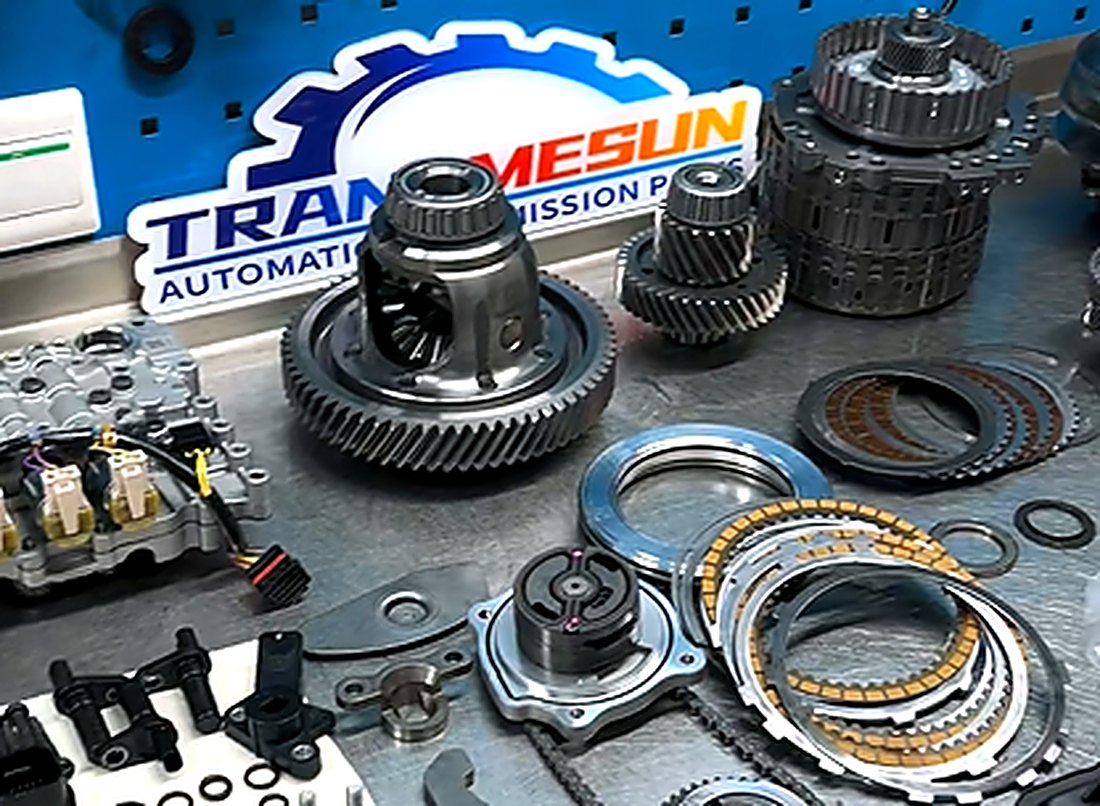
Quick answer. For a JF016E / RE0F10D, the difference between new, remanufactured and used is mostly about what ships with the unit, not the metal. A new valve body carries a factory calibration identity; a properly remanufactured one carries a fresh measured identity plus new wear parts (belt, bearings, seals, friction); a used unit carries somebody else's wear history and, on this platform, no calibration file at all until you generate one. Decide by three things: belt condition, valve body serial traceability, and who pays for the IP characteristics file — not by the adjectives in the listing.
The CVT8 generation makes this comparison sharper than the JF015E did, for one reason: JATCO calibrated every control valve body individually, and the calibration lives in a file, not in the hardware. Two valve bodies of the same part number 31705-28X0B are not interchangeable without that file travelling with them. That single fact quietly changes what "used" means, what a remanufacturer must re-measure, and which questions you should ask before ordering. The full calibration mechanics are in our JF016E programming article; here we apply them to the buying decision.
This is part of the JATCO CVT hub series. The companion pieces cover the family and its aliases, the fault codes, the OE part numbers, the inspection sequence, the rebuild kit contents and the three-family comparison. If you came here from the JF015E world, our JF015E new vs reman article covers the same ground for the smaller belt-driven unit.
01Four words, four completely different processes
Listings use "new", "OEM", "remanufactured", "refurbished" and "used" almost interchangeably. They are not interchangeable, and on the JF016E the gap between them is wider than on most transmissions because of the calibration issue.
| Label | What it should mean | What actually ships (ask, don't assume) | Calibration file |
|---|---|---|---|
| New (genuine JATCO/Nissan) | Factory unit, sealed, with its measured IP characteristics tied to the serial | The part — but confirm the file provisioning route: dealers write it against the serial at the bench | Yes, tied to the unit serial |
| New (aftermarket assembly) | Third-party built unit | Varies widely; the CVT8 belt and pulley tolerances are the hard part to replicate | Often missing — verify before ordering |
| Remanufactured | Disassembled, cleaned, wear parts replaced, re-measured, bench tested | A unit with a new measured identity; ask what was replaced and what the bench report covers | Should ship with the QR/serial that supports a fresh Write IP Chara |
| Refurbished / cleaned | — (unregulated word) | Usually washed and resealed; wear parts untouched | Old file data may not match the hardware anymore |
| Used / salvage | Pulled from a wreck | Unknown history, unknown belt state, unknown fluid life | No file — you must generate one from VIN + serial |
The honest summary: "remanufactured" is only worth more than "used" if the remanufacturer replaced the wear parts and re-measured the calibration identity. Washing a valve body and bolting it back together is neither. Everything below is about how to tell the difference from the outside.
02What actually wears inside a JF016E — and what it means for a reman unit
A remanufacturing claim is only as good as the wear-part list behind it. On the CVT8 these are the items that actually degrade, in rough order of how often they end a unit's life:
| Component | Wear mode | Why cleaning cannot save it | Our position in a reman build |
|---|---|---|---|
| Push belt (901074 family) | Element edge rounding, pin wear, friction-coating loss | Wear is inside the belt elements; the rounded-edge vs sharp-edge check under magnification is the honest test | Always new in a reman build. A "reman" unit with a used belt is a used unit wearing a nicer label |
| Valve body bore wear | Pressure leakage past worn spools → P0776-family codes | Bore wear is metal removed; no wash or polish restores it | Flow-tested on the bench; bodies failing spec are replaced, not "improved" |
| Oil pump rotor set | Scoring, clearance growth, flow loss — and the flow-control valve sticking first, as we saw on the 39k-mile Altima in the inspection article | Clearance is a machined dimension | Measured against spec; replaced as a set when out of tolerance |
| Friction packs | Face glazing, lining loss (FWD 138 mm / 36-tooth, REV 178.4 mm / 40-tooth on this family) | Friction material is a consumable | Always new — see the kit contents article |
| Differential bearings & seals | Pitting, noise, leakage | Pitting does not polish out | Replaced on condition; seals always new |
| Pulleys | Groove shoulder wear, surface polishing where the belt slips | Once the faces polish, the belt needs matching replacements | Inspected with the belt; replaced as a matched set when either is worn |
Notice what heads the list: the belt. It is the single most expensive consumable in the unit, the most commonly fudged line in cheap rebuilds, and the part whose condition decides whether a hydraulic repair (valve body, pump) will even hold. Nissan's own guidance on this generation — the borescope inspection flow in TSB MC-10199124 with tool J-51951 — exists precisely because a belt you can see through a plug hole is cheaper to judge than a unit you have already installed.
03The calibration question that separates suppliers on this platform
On the JF015E, a replacement valve body mostly needs a relearn. On the JF016E it needs the file. Every control valve body carries its own measured flow characteristics, and the TCM cannot re-derive them; fit a body without writing its IP characteristics and the usual result is a P17F0 or P17F1 that no scan tool will clear. That is the core of our programming article.
For the buying decision, the practical consequences are these:
| Unit type | What the calibration means for you |
|---|---|
| New genuine | The serial is recognized by the dealer tooling; the file write is a routine step |
| Remanufactured (proper) | The body has been flow-tested and carries a serial/QR that supports a fresh Write IP Chara — ask for it explicitly |
| Remanufactured (cheap) | The body was washed, not measured. The old serial may no longer describe the hydraulics, and nobody owns that mismatch |
| Used salvage | No file in the vehicle, no paperwork, serial possibly worn or painted over — generating the file becomes your workshop's problem, and sometimes it cannot be done at all |
That last row is the quiet trap of the salvage market on this generation. A used JF016E offered attractively can become the most expensive option on the job the day the shop discovers the range-switch QR is unreadable and the case serial does not resolve. The nameplate and identification guidance on the JATCO CVT hub covers how to read and photograph those codes before money moves.
04What "new" actually means for a JF016E unit in 2026
Genuine new CVT8 hardware exists through the dealer channel, and for some part numbers it is the right call — particularly complete assemblies for vehicles under warranty policies that require documented new parts. But three realities shape the decision for independent shops:
Availability is application-dependent. The RE0F10D served a huge population (Altima 2.5, Rogue T32, Qashqai J11, X-Trail T32, Sentra and more — the applications chart lists the windows), but as the fleet ages, dealer stocking of complete assemblies thins out and lead times stretch. Sub-assemblies like valve bodies and filters (31728-28X0A) remain the more reliably stocked layer.
"New" does not mean "no paperwork". Even a new unit needs the IP characteristics written against its serial at installation. If a supplier cannot tell you which serial ships and how the file gets provisioned, the unit's newness does not shorten the job.
New does not excuse diagnosis. We see units ordered new for judder complaints where the belt was fine and the actual fault was calibration or fluid — the new unit then inherits the same complaint. The code-to-part mapping exists to stop that spend before it happens.
05When a remanufactured JF016E is the right call — and what to demand
A reman unit makes sense when the case, wiring and major castings are sound but the wear items are done — which is the common failure shape of this family at moderate mileage: valve body wear codes plus a belt approaching the rounded-edge threshold. What separates a real reman from a wash-and-seal is documentation, and it is all askable in five questions:
| # | Ask any supplier | Good answer looks like |
|---|---|---|
| 1 | Was the push belt replaced with a new unit, and can you prove it? | Yes — new belt, part number stated (901074 family), fitted as a matched set with inspected pulleys |
| 2 | What was the valve body flow test result? | Bench flow-tested against spec; failing bodies replaced with measured units, serial stated |
| 3 | Which friction and steel plates are in the box? | New FWD/REV friction (138 mm/36T, 178.4 mm/40T) and steels; master kit contents stated honestly, including what it does not include |
| 4 | Does the unit ship with its serial/QR so our tooling can write IP characteristics? | Yes — QR intact on the range switch, serial documented on the paperwork |
| 5 | What does the bench test cover before dispatch? | Pressure behaviour across the operating range, solenoid response, leak checks — in writing |
A supplier who answers those five in writing is selling a remanufactured unit. A supplier who answers "fully tested, like new" in prose is selling a hope. Our own floor is the same standard we describe: every valve body and assembly is bench-tested before it leaves the building, wear consumables go in new, and the calibration identity ships documented — that is what the 20 test devices and 5 QC inspectors on our 10 production lines are for, and it is why roughly 65% of our orders come from buyers who have ordered before.
06When nothing but a complete assembly will do
Some findings end the repair-versus-replace debate on the spot. These are the ones we treat as assembly-level verdicts, and they mirror the honest inventory matrix we keep on the JATCO CVT hub:
| Finding | Why it ends the debate | Source of truth |
|---|---|---|
| Belt elements worn past the rounded-edge threshold, or belt slip with polished pulley faces | Belt and pulleys wear as a matched pair; both are core rotating hardware | Borescope check, TSB MC-10199124 method |
| Case cracks, mounting boss damage, stripped bores | Machined structure; not remanufacturable at sensible cost | Visual + dye check on arrival |
| Pump damage with metal contamination circulated through the circuit | Debris travels; every hydraulic surface is suspect | Inspect the pan and filter (31728-28X0A) for glitter |
| Multiple failed subsystems (valve body + pump + differential) | Sum of parts and labour approaches assembly territory, with nobody accountable for the whole | Simple arithmetic, honestly done |
Note the pattern: it is rarely the valve body alone that forces an assembly decision. It is the belt, the case, or contamination. That is why the first hour of any CVT8 job should be spent on the inspection sequence, not on ordering parts.
07When a used JF016E is still a rational choice — and how to check one
We are not going to pretend the salvage market does not exist; for older, low-value applications it sometimes is the only rational input. If you go that route, check these before committing, because every one of them is a documented failure point on this platform:
Read the identity first. Photograph the range-switch QR and the case serial before paying. If they do not resolve, the calibration path is broken — walk away, whatever the saving looked like. The identification guidance on the JATCO CVT hub shows exactly where to look.
Judge the belt through the inspection port. J-51951 or a generic borescope: sharp element edges and clean coating are pass; rounded edges, flaking coating, or polished pulley faces are an assembly-grade verdict on a unit that is supposedly "just the valve body".
Open nothing you cannot re-seal — but do read the pan and filter (31728-28X0A) if the unit comes with drain history. Glitter in the pan is a whole-unit story.
Cost the file before the unit. Whoever installs it will need the IP characteristics write — confirm who sources it and what it takes, in your market, with your tooling, before the unit is paid for. Compare that total against a documented reman and the picture is usually clear.
08What happens to a JF016E unit before it leaves our building
For transparency, here is the actual sequence every valve body and assembly passes through at our Huadu facility — the same floors you can walk through in our 360° virtual factory tour:
Disassembly and wash. Incoming units are stripped and cleaned; the disassembly bay panoramas show the tanks and benches. Nothing is assessed in a dirty state.
Measurement. The belt goes under magnification for the edge check; pump clearances are measured against spec; the valve body is flow-tested on the bench and either passes or is replaced — we do not sell "improved" bodies.
Rebuild with new consumables. New belt, new friction and steels, new seals and gaskets, bearings on condition — the parts list from the kit contents article is the reference we build against.
Bench test and paperwork. Pressure across the range, solenoid response, leak check — then the serial and QR are photographed onto the paperwork so the shop that installs it can write IP characteristics without a scavenger hunt. Then packing: foam, carton, plywood crate, in that order — the export crating bay does nothing else.
09The five questions that make any two offers comparable
Whatever supplier you use — us or anyone else — these five lines collapse most of the fog between listings. Ask them identically of both offers and the difference usually explains itself:
1. Belt: new, and which part number? 2. Valve body: flow-test result and serial? 3. Friction and steels: new, and which kit contents? 4. Calibration: does the serial/QR ship documented, and who writes the file? 5. Bench test: what was tested, and will you send the result?
If an offer cannot answer those in writing, it is not a remanufactured unit in any sense that helps your workshop. If it can, you are comparing real things, and the decision becomes ordinary engineering arithmetic instead of trust in adjectives.
10How to order the right one the first time
Send us the same four things regardless of whether you end up wanting a valve body, a kit or an assembly: the housing code photograph, the vehicle VIN, the stored fault codes, and a photo of the original valve body showing the solenoid layout. Our engineers confirm the exact JF016E version and state stock, condition and lead time in writing — normally within four business hours, on WhatsApp at +86 134 3039 1618 or through the inquiry form.
If the verdict is genuinely assembly-level, say so plainly — the honest matrix of what we stock per family sits on the hub page, and we would rather tell you a unit is past economic repair than ship you a valve body for a belt problem. That is also how the inspection guide ends, and it is not a coincidence: the inspection decides the buying decision, every time.
11Sources and frequently asked questions
Technical basis for this article: Nissan TSB MC-10199124 (CVT belt borescope inspection, J-51951), Nissan TSB NTB21-051 (judder diagnostics and belt/pulley replacement criteria), JATCO CVT8 service documentation for the RE0F10D platform, and our own bench records across 10 production lines. Where sources disagree on a number, our cluster articles say so and show both.
Is a remanufactured JF016E valve body as reliable as new?
A properly remanufactured body — one that was flow-tested against spec, has its wear items replaced, and ships with a documented serial for calibration — does the same job as new for the hydraulic symptoms it is meant to fix. What "as reliable as new" cannot mean is a body that was washed and resealed. The five questions in section 09 exist to tell those apart in one email.
Do I need programming after fitting a remanufactured JF016E valve body?
Yes. Every JF016E valve body carries its own measured IP characteristics, and the TCM will not recognize new hardware without the matching write. A reman body should ship with its serial/QR documented so your tooling can perform Write IP Chara — the twelve-step procedure and tool capability table are in our programming article.
Why is the belt such a big deal in the new-vs-reman decision?
Because it is the wear part that hydraulic repairs cannot rescue. A reman valve body fitted to a unit with a worn belt buys you weeks, not years — the judder codes return as the belt's friction loss grows. Nissan's borescope TSB exists for exactly this decision. In any reman build we do, the belt is new; a "reman" unit with a used belt is a used unit.
Can I use a salvage JF016E to save the job?
Sometimes, but cost out the calibration path before you commit to the unit. A salvage body without a readable serial/QR may be impossible to calibrate at all, and a salvage assembly inherits unknown belt and pump history. If the pan shows glitter or the belt edges are rounded, the saving is imaginary.
What should a master rebuild kit include for the JF016E — and what does it usually leave out?
Friction packs (FWD 138 mm/36T, REV 178.4 mm/40T) and steels, seals, gaskets and bearings — but master kits commonly omit six items you will want: see the full cross-reference in the kit contents article. The belt is ordered separately and always new.
How long does a remanufactured JF016E last?
Depends mostly on two things you control: the belt was new going in, and the fluid stays NS-3 on the correct service interval (7.9 L fill on this family). With those two held, a properly rebuilt unit's life is governed by the same variables as a new one — heat, contamination and driving pattern, not the label on the invoice.
What comes back if I send you the codes and VIN?
A written verdict on which part actually matches the fault — valve body, kit or assembly — with stock, condition and lead time stated. If the fault points at calibration rather than hardware, we say that too; it has saved more than one workshop from ordering the wrong box.
Is the JF016E the same unit as the JF017E, just with a different name?
No. The JF016E / RE0F10D is a belt-driven CVT8 rated to 250 Nm; the JF017E is the chain-driven 380 Nm sibling with different pulleys, belt-to-chain hardware and valve body family. The three-way comparison with the JF011E is in our family comparison article.