
On this page
- The one-line answer
- How to read a Nissan part number on a JF015E valve body
- The complete 31705 list for the JF015E
- The US supersession path
- The international stream
- Open cap versus closed cap
- Kit or complete assembly
- The number that is not a JF015E
- What to photograph, and what comes back
- Sources and frequently asked questions
Type any of those numbers into a marketplace search box and you will get a page of listings that all claim to fit the same cars. Most of them are honest about the number and wrong about the fitment. This page is the reference we keep on the bench: what each number actually is, which numbers supersede which, the one solenoid exchange that is allowed, and the stamp on the housing that overrules every list — including ours.
What this page gives you
- The complete 31705 list we work with, separated by market and by version.
- The supersession path X429B → X429C → X429D, and what a trailing letter really means.
- The open cap versus closed cap rule — the only direction of exchange that is safe.
- Why 31705-50X0B is a different family, and how to tell in ten seconds that you have one.
- The housing stamp codes that identify the unit far more reliably than a vehicle year chart.
01The one-line answer
If you only read one line: the part number identifies the version of the valve body, not the car. Four things change the version — market (US versus international), engine (1.6L versus 1.8L in some markets), solenoid cap type (open versus closed), and control-valve calibration (the trailing letter). All four are stamped or printed on the unit you already have, which is why we ask for a photograph of the original before confirming anything.
Everything below exists to make that photograph easy to take and easy to read.
02How to read a Nissan part number on a JF015E valve body
Nissan part numbers follow a fixed shape: five digits, a dash, then five more characters — for example 31705-X429D. The first group is the part category, and it is the part you can trust without any catalogue: the same category number appears on the same kind of component across an enormous number of Nissan transmissions.
| Prefix | Category | What it means on a JF015E |
|---|---|---|
31705 | Control valve / valve body assembly | The complete valve body as an assembly. This is the number most buyers are actually looking for. |
3170E | Control valve repair / service kit | A kit rather than a bare assembly — gasket and valve body filter included. |
31941 | Control valve solenoid | Individual solenoids, sold by position and cap type. |
31214 | Pulley and belt set | The primary/secondary pulley and belt assembly, some with the rear cover. |
31340 | Oil pump | Pump body or pump assembly kit. |
21606 | Oil cooler | External CVT fluid cooler, by pipe count and market. |
The second group is the one that decides everything. X429 and 3JX8 are not interchangeable codes for the same thing — they are the US-market and the international-market development streams, and they exist because the two calibrations were developed separately. That single distinction causes more wrong orders than any other in this family.
03The complete 31705 list for the JF015E
Every valve body number below is one we handle. The column that matters most is the third one: which unit it goes back into. Where the two markets overlap on a vehicle name, the unit in the car is the only thing that decides.
| Part number | Version | Goes into | Notes |
|---|---|---|---|
31705-X429B | US version | JF015E in US-market applications | The number most US rebuilders have on the shelf. Superseded in service. |
31705-X429C | US version | Same applications, later build | Superseding number; internally revised. |
31705-X429D | US version | Same applications, latest build | The current US number in most catalogues. |
31705-3JX8A | International version | JF015E outside North America — both 1.6L and 1.8L | One number covers two engine sizes in this stream. |
31705-3JX5D | International, open-coil | Units built with open-coil solenoids | Also appears as 31705-3JX3E and 31705-3JX4C in European catalogues. |
3170E-X427D / 3170E-X427E | US kit | Same US applications | Assembly plus gasket plus valve body filter, as one kit. |
31705-50X0B | Six-solenoid unit | RE0F11B / RE0F12A / JF020E | Not a JF015E valve body. Listed here so you can rule it out. |
A marketplace interchange list for this family will happily bundle X427D, X428A, X428C, X429B, X429C, X429D, X429E, X422C and 04X7E into a single "fits" claim. Those numbers share a housing footprint and a connector, and they do not all share a calibration. A bundled list is a research starting point, never a fitment confirmation.
04The US supersession path: X429B → X429C → X429D
The trailing letter is a build or calibration revision, not a different part. In everyday trade practice a later US suffix replaces the earlier one, which is why a 2014 unit that left the factory with an X429B is normally serviced with a later number.
Two honest caveats, because we get asked this constantly:
- A replacement is not an upgrade. Nothing in the number tells you what changed inside. Some revisions address a specific complaint, some are production-convenience changes. If your unit failed for a reason that is not inside the valve body — a slipping belt, contaminated fluid, a failing pulley surface — no suffix will fix it.
- The letter cannot tell you which calibration the car was built with. Only the housing stamp and the stored code history can, and both survive in the vehicle long after the original valve body is gone.
So we treat the supersession path as useful, one-directional, and insufficient on its own. It narrows the shelf to one region; the housing stamp picks the row.
05The international stream: 3JX8A, 3JX5D and the European numbers
Outside North America the same transmission was built to a different calibration and carries a different development code. The three you will meet:
| Number | Stream | Solenoid cap | Where it shows up |
|---|---|---|---|
31705-3JX8A | International | As originally built | Catalogued for both the 1.6L and 1.8L international applications. |
31705-3JX5D | International | Open coil | The later international build; supplied new rather than remanufactured in most catalogues. |
31705-3JX3E / 31705-3JX4C | European cataloguing | Early and mid builds | Early-style European valve bodies, typically supplied as rebuilds with the high clutch pressure switch fitted. |
If your car was built for a market outside North America, the US number is the wrong answer even when the vehicle name matches. Compounding this: the same nameplate was sold with different transmission calibrations depending on the plant that built it, so two cars with the same badge and the same year can carry different valve bodies. This is not a catalogue error. It is the normal condition of this family.
06Open cap versus closed cap — the one exchange that is allowed
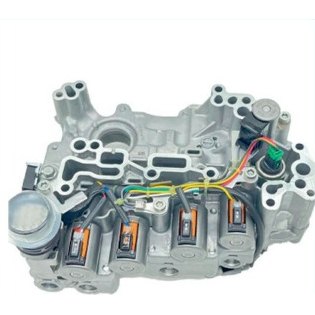
Solenoid coils in this valve body were built in two physical styles: a closed (encapsulated) coil and an open coil. Externally they sit in the same bore and plug into the same connector body, which is exactly why they get mixed up.
Closed-coil solenoids can be replaced by open-coil solenoids. Open-coil solenoids must never be replaced by closed-coil solenoids.
The open coil is the later development — it dissipates heat better and is less prone to the coil damage that follows sustained overheating. Going forward is a service improvement. Going backward reintroduces the failure the change was made to remove, and it will come back.
Practical consequence: a valve body supplied with open-coil solenoids is not "the wrong one" for a car that left the factory with closed coils. The reverse is what you have to refuse.
Solenoids are catalogued individually by position and cap type, and the trade also supplies them as a matched set of four — three of one position rating and one of the other, in the same cap style. If you are replacing one solenoid, the cap style of the ones already in the unit tells you which set to order; if you are not sure, a photograph of the solenoid side of the valve body settles it.
07Kit or complete assembly: what 3170E-X427D actually contains
The 3170E prefix marks the service kit for the same US applications rather than a bare valve body. The kit adds the two consumables that a bare assembly does not include and that quietly cause repeat failures when they are reused:
- The valve body gasket — a reused gasket that has taken a compression set will leak across a channel the unit cannot see and cannot report.
- The valve body filter — the last screen before the control valves. Debris that gets past it does not stop at the valve body.
Choosing between them is a question of what is actually being replaced. If the valve body is coming out, the consumables around it are the cheapest part of the job and the most likely to undo it.
08The number that is not a JF015E: 31705-50X0B
The six-solenoid valve body 31705-50X0B is listed in this family because it shares a family name and a supplier, not because it interchanges. It belongs to the RE0F11B / RE0F12A / JF020E group — the wide-ratio CVT7 development.
You can separate the two families before taking anything apart, using the stamp code on the transmission rather than the car's badge:
| Stamp code | Unit | Typically seen on |
|---|---|---|
3JX4E | JF015E / RE0F11A | 2012 Versa 1.6L |
3JX6C | JF015E / RE0F11A | 2013–2019 Versa 1.6L, 2014–2019 Versa Note 1.6L |
X427E | JF015E / RE0F11A | 2013–2018 Sentra 1.8L |
X428E | JF015E / RE0F11A | 2016–2018 Sentra 1.8L |
50X1A / 50X5A | JF020E (wide ratio) | 2018–2019 Kicks 1.6L |
Note the shape of that table: the 50 series is the wide-ratio unit. If you see a 50 where you expected X42 or 3JX, stop and change families — every part downstream of the valve body differs as well. We cover that comparison in full on the JF015E versus JF020E page.
09What to photograph, and what comes back
The valve body number is often unreadable on a used unit — label worn, number inked onto a machined face, or gone entirely because someone already replaced the part. The vehicle still carries better evidence than the part does:
| Send us | Where it is | What it settles |
|---|---|---|
| Housing stamp code | Stamped or cast on the transmission case | Which unit is in the car — the single most useful item on this list. |
| VIN | Windscreen or door jamb | Build market and engine, which points to the right development stream. |
| Solenoid-side photograph | The valve body you are replacing | Open versus closed cap, solenoid count, connector body. |
| Stored fault codes | Any scanner with CVT live data | Whether the valve body is actually the failed part. |
| Fluid condition | Dipstick or drained sample | Whether metal or belt debris has been circulating — which changes the answer completely. |
With those five items we confirm the version, the part number, stock and lead time in writing within four business hours. Minimum order is one piece; every assembly is dyno-tested and every valve body is flow- and pressure-tested on a computerised bench before it leaves the building.
Valve body numbers, supersession grouping and the six-solenoid family separation are cross-checked against our own bench records and two independent aftermarket catalogues (Berkeley Standard JF015E/RE0F11A valve body and hard-parts listings; Automatic Choice JF015E European valve body identification sheet), with the OE number groups matched against Nissan part-number conventions. Stamp-code applications are cross-checked against the transmission stamp tables used in the North American aftermarket. Where sources disagree on a market designation — the same six-solenoid unit is filed under RE0F11B in some catalogues and RE0F12A in others — we say so rather than picking one. Nothing on this page replaces the code stamped on your own transmission housing.
10Sources and frequently asked questions
Is 31705-X429D a direct replacement for 31705-X429B?
In the US stream, yes — X429D is the later build of the same US-market valve body and supersedes X429B and X429C. The physical fit and the connector are the same. What the letter does not guarantee is that the calibration matches the car, particularly if the car was built for a market outside North America. Confirm against the housing stamp before you order.
Can I use a 31705-3JX8A in a US-market car?
Only if that car was built to the international calibration. 3JX8A is the international development stream and covers both the 1.6L and the 1.8L in that stream. The connector and housing footprint may suit, and the calibration will not match a US-market control strategy. This swap is where most "it fits but it drives wrong" reports come from.
Is 31705-50X0B a JF015E valve body?
No. 31705-50X0B is the six-solenoid valve body for the RE0F11B, RE0F12A and JF020E group — the wide-ratio CVT7 development. It is not interchangeable with any JF015E valve body. If your housing carries a 50-series stamp you have the wide-ratio unit, and the pulley set, belt and valve body all differ from the JF015E.
Can I replace a closed-cap solenoid with an open-cap one?
Yes. The open-coil solenoid is the later development and was introduced to dissipate heat better and reduce coil damage from sustained overheating. Upgrading closed to open is an accepted service change. The reverse is not: never fit a closed-cap solenoid where an open-cap one belongs, because it reintroduces the failure the change was made to remove.
Do I need the kit 3170E-X427D or just the valve body?
The kit adds the valve body gasket and the valve body filter. If the valve body is coming off the transmission, those two items are being disturbed anyway, and a reused gasket is a common cause of a job that has to be done twice. The kit exists for that reason.
My old valve body has no readable part number. What do I do?
Work from the vehicle instead of the part. Send the stamp code from the transmission housing, the VIN, a photograph of the solenoid side of the valve body, the stored fault codes and a note on the fluid condition. Those five items identify the version more reliably than a worn label, and they make the fluid history visible — which decides whether a valve body alone is the right answer.
Why do online interchange lists show numbers that your table separates?
Because those lists group by housing footprint and connector, which do interchange, and treat calibration as a detail. The numbers genuinely do share a physical envelope. They do not all share a control strategy, and the difference shows up as a car that runs but shifts wrongly rather than a car that will not start. Treat a bundled list as a starting point and confirm against the housing stamp.
How do I confirm which valve body my unit needs?
Send the transmission housing code, the VIN, the stored fault codes, a photograph of the original valve body from the solenoid side, and the fluid condition. We confirm version, part number, stock and lead time in writing within four business hours. Minimum order is one piece, and every valve body is flow- and pressure-tested on a computerised bench before dispatch.