
On this page
- Four words, four completely different processes
- What actually wears inside a JF015E valve body
- The parts cleaning never fixes
- The calibration question that separates suppliers
- What "new" actually means for a JF015E valve body in 2026
- When a used valve body is the right call
- First question
- What happens to a JF015E valve body before it leaves our building
- Five questions that make two offers comparable
- How to order the right one the first time
- Sources and frequently asked questions
Every week a workshop writes to us with the same sentence: "I can get this from another supplier, is it the same part?" Sometimes it is. Often it is a cleaned used valve body with new O-rings and a fresh coat of paint, and the difference only shows up 4,000 km later when the shudder comes back and the customer is standing at the counter. This page is the comparison we would give a rebuilder who asked us face to face: what each of the four words actually commits the seller to, what physically fails inside a JF015E valve body, and the five questions that separate a real remanufactured unit from a repackaged one.
What this page gives you
- The four product categories defined by process, not by marketing language.
- The wear map of a JF015E valve body — which bore fails, which symptom it produces, and which fault code follows.
- The electrical parts that cleaning never fixes, with the resistance window at three fluid temperatures.
- What a used unit can still be good for, and the three checks to run before fitting one.
- The five questions that make two offers comparable without arguing about anything else.
01Four words, four completely different processes
The words are not grades of the same thing. In the North American aftermarket, remanufacturing is a defined industrial process: complete disassembly to bare components, inspection of every part against OE specification with gauges and micrometers, replacement of all wear items whether or not they look worn, reconditioning of components that are still within tolerance, reassembly to OE torque and clearance, testing of the finished unit, and documentation of what was done. Rebuilding has no such definition. It can mean the same discipline performed by a careful specialist, or it can mean "we cleaned it and replaced the seal that was leaking".
That gap matters more on a CVT valve body than on a starter motor, because the failure mode is invisible. A worn bore does not announce itself with a broken part. It cross-leaks a few hundred millilitres a minute of pressurised oil past a spool that still slides freely by hand, and the only way to see it is to measure the bore or vacuum-test the circuit.
| What is sold as | What is physically done | What is normally tested | What you are trusting |
|---|---|---|---|
| New (genuine OE) | Fresh casting, fresh valves, fresh solenoids, factory calibration | Factory end-of-line test | The supply chain and the number on the box matching your unit |
| New (aftermarket) | New casting or new machining, aftermarket solenoids, calibration copied from a reference unit | Varies; often a flow check only | The supplier's casting quality and solenoid source — both invisible from outside |
| Remanufactured | Full teardown, clean, bore reconditioning where worn, all wear items replaced, reassembly, calibration loaded | Electrical at temperature, bore vacuum, flow, line pressure, leak-down | The process discipline and whether it was actually followed on your unit |
| Rebuilt | Whatever the seller chose — often the visibly failed parts only | Sometimes nothing beyond "it moves" | Nothing you can verify from the label |
| Used / pull-out | Removed from a donor vehicle, drained, sometimes washed | Nothing | The donor car's history, which nobody has |
| Cleaned and resealed | Ultrasonic clean, new gaskets, new O-rings, original valves and solenoids | Often a solenoid buzz test only | That the wear which caused the original failure was in the cleaning, not the metal |
Note the last row. "Cleaned and resealed" is the most common thing actually sold as remanufactured on trading platforms, and it is the one that fails predictably, because the bore wear that produced the customer's complaint is still there when the unit goes back in the car.
02What actually wears inside a JF015E valve body
The JF015E hydraulic layout is compact and heavily loaded. The secondary pulley circuit doubles as main line pressure, and it feeds the primary pulley regulator valve, the solenoid regulator valve, the TCC regulator valve and the TCC control valve. That single fact explains most JF015E valve body behaviour: when the secondary pulley / pressure regulator valve or its bore wears, the loss is not confined to one function. Every valve downstream sees the consequence, which is why one worn bore can produce shudder, a slip complaint, a ratio code and a lock-up complaint on the same car.
| Circuit | Valve involved | What wear does | What the driver reports | Codes that follow |
|---|---|---|---|---|
| Secondary pulley / main line | Secondary pulley / pressure regulator valve | Cross-leak exhausts pressure and volume; inboard spool wear can also raise line pressure | Chatter on acceleration, belt slip, RPM surge, ratio that will not move | P0776, P0841, P0868, P17F0 family |
| Primary pulley | Primary pulley regulator valve | Loss of primary pressure control at the top of the ratio range | Will not reach the highest ratio, flare at light throttle | P0746, P0730, ratio deviation codes |
| Solenoid feed | Solenoid regulator valve | Regulated feed to all control solenoids goes low or high | No ratio change, noise on acceleration, belt and pulley wear accelerating | P0965, P0962, P0963 |
| Boost / line rise | Boost valve and sleeve | Line pressure does not rise with torque demand | Slip under load that disappears when cruising | P0841, P0868 |
| TCC | TCC regulator and TCC control valves | Converter apply pressure unstable or slow | Shudder at steady 50–80 km/h, lock-up cycling | P0740, P0744, P17F1 |
| Manual / selector | Manual valve | Selector position not hydraulically confirmed | Delayed engagement, no reverse | P0705, P0706 |
This is also why a remanufactured unit has to be judged on the bores, not on how clean it looks. A used valve body can be spotless inside and still have three bores out of tolerance. Conversely a core with 180,000 km on it can be perfectly serviceable if the fluid was changed and the unit never overheated — which is exactly why the core quality question matters to the remanufacturer and not to you.
03The parts cleaning never fixes
A JF015E valve body carries five control solenoids, one pressure sensor, one fluid temperature sensor and a memory device. Cleaning restores none of them. Ultrasonic cleaning can even make a marginal solenoid worse by removing the varnish that was quietly helping it seat.
The resistance windows below are the ones published in the ATSG CVT 7 technical material for the JF015E / RE0F11A / F1CJB, measured from the case connector with each solenoid internally grounded. The important detail is that the window moves with temperature — a coil that reads 5.3 Ω cold and 6.7 Ω hot is healthy, and a technician who tests only cold will pass a coil that is failing when the transmission is at operating temperature.
| Solenoid | Function | 20 °C (68 °F) | 50 °C (122 °F) | 80 °C (176 °F) |
|---|---|---|---|---|
| Line pressure solenoid A | Main line pressure control, normally high | 5.3 Ω | 6.0 Ω | 6.7 Ω |
| Primary pressure solenoid B | Primary pulley pressure, normally high | 5.3 Ω | 6.0 Ω | 6.7 Ω |
| Low brake solenoid F | Auxiliary gearbox low brake, normally low | 5.3 Ω | 6.0 Ω | 6.7 Ω |
| High clutch & reverse brake solenoid G | Auxiliary gearbox high clutch and reverse brake, normally high | 5.3 Ω | 6.0 Ω | 6.7 Ω |
| TCC solenoid | Converter lock-up, normally low | 6.1 Ω | 6.9 Ω | 7.7 Ω |
Two further checks belong in the same pass. The CVT fluid temperature sensor reads 6.5 kΩ at 20 °C, 2.2 kΩ at 50 °C and 0.87 kΩ at 80 °C (2.00 V, 1.50 V and 0.90 V on the signal line). The secondary pulley pressure sensor is a plausibility check rather than a hard limit: the ATSG material lists 0.88–0.94 V at idle in neutral, while an aftermarket rebuild guide lists 0.48–0.52 V for the zero position. They are describing two different conditions — pressurised idle versus no pressure — which is why we log the voltage at both and compare, instead of treating either figure as a pass mark.
Then there is the part almost nobody mentions. The JF015E control valve assembly contains a ROM / EEPROM device holding solenoid calibration data, and a high clutch pressure switch that is wired to terminal 17 on at least some units and does not appear in Nissan wiring diagrams. A remanufacturer who does not know the switch exists will not test it, and a unit that arrives with a dead switch behaves like a unit with a hydraulic fault. We cover the calibration side of this in the programming and relearn article; here the point is narrower: if the seller cannot tell you what happens to that memory device during the rebuild, the rebuild is not finished.
04The calibration question that separates suppliers
Because the solenoid calibration lives with the unit, a remanufactured valve body has to leave the bench with calibration data that suits the transmission it is going into. In the US reman market this is visible in the offer structure: some builders list "calibration matching based on VIN" as a paid extra, which tells you the default unit ships with a generic reference calibration and that the car will do the rest of the work through adaptive learning.
That is a legitimate approach and it usually works, because the TCM learns clutch points and pressure offsets over the first few drive cycles. It stops working when the unit is going into a car with a different market calibration, a different final drive, or a TCM that has already adapted to a worn valve body. Our own practice is to confirm the market stream and the trailing letter from the housing stamp before the unit is selected, load the matching calibration, and tell the customer in writing which initialization sequence the car will need. That is also why we ask for a photograph and a code rather than an order form with a part number typed into it.
If a supplier cannot answer "which calibration goes into this unit and what does the installer have to do afterwards", the unit is being sold as a casting, not as a control assembly. On a JF015E that distinction is the whole job.
05What "new" actually means for a JF015E valve body in 2026
Genuine new JF015E valve bodies exist, but the supply is thin and the number you need may be a superseded one. A new unit removes the wear question entirely — that is its real advantage, and for a fleet with a fixed replacement interval or a car under a manufacturer obligation it can be the correct choice regardless of anything else on this page. Its disadvantage is that "new" is the easiest word in the industry to put on a box that contains something else.
If you are buying new, the checks are physical, not verbal: casting quality and machining marks on the spool bores, solenoid body branding and cap type (open versus closed — the exchange direction is one way only), presence and version of the memory device, and whether the number on the unit matches the number on the documentation. A new aftermarket casting with unbranded solenoids is a different product from a genuine assembly, and the two are routinely offered under the same description.
| Option | Real strength | Real weakness | Makes sense when |
|---|---|---|---|
| Genuine new | Zero wear history, factory calibration, factory traceability | Supply and supersession risk; the tightest supply | Fleet interval replacement, warranty obligation, or a customer who will not accept a core-based part |
| Aftermarket new | Availability, and no core to return | Casting and solenoid quality vary enormously and are invisible until the unit is running | Only with a supplier who will state the solenoid source and stand behind the unit in writing |
| Remanufactured | OE casting and OE solenoids, all wear points addressed, tested at temperature, core recycled | Quality is entirely process-dependent — the word alone guarantees nothing | The transmission itself is sound and the failure is hydraulic or electrical |
| Rebuilt | Can be excellent from a known specialist | No standard, no documentation, no way to compare | A local builder you have used for years on this platform |
| Used | Immediate availability; the only option for a discontinued variant | Inherits the donor's wear, often the same wear that failed yours | Diagnostic substitution, a car being sold, or a stopgap while a reman unit ships |
06When a used valve body is the right call — and how to check one
There are honest uses for a used JF015E valve body. The strongest is diagnostic substitution: you have a car with a hydraulic complaint and you want to know whether the valve body is the cause before committing to a rebuilt unit. A known-good used unit borrowed from a running car answers that question in an afternoon. The second is a vehicle being prepared for sale where the buyer has been told the transmission is "as inspected". The third is a rare variant where no reman supply exists.
Outside those cases, a used unit is a gamble with a measurable downside, because the population of used JF015E valve bodies is dominated by units removed from cars that failed — and a large share of those failures were hydraulic. "Low mileage" is the most common claim and the least verifiable; there is no odometer on a valve body.
| Check before fitting a used unit | How | What failure looks like |
|---|---|---|
| Solenoid resistance, cold and hot | Case connector, each terminal to ground, at 20 °C and again after a heat soak | Open circuit, or a coil that drifts outside 5.3–6.7 Ω (6.1–7.7 Ω for TCC) as it warms |
| Bore vacuum test | Vacuum gauge on the port for each regulator circuit, per the published vacuum test guide for this unit | Vacuum that bleeds away instead of holding — bore or spool wear, even if the spool feels tight |
| Casting flatness and port faces | Straight edge across the mating face, visual on the separator plate and gasket tracks | Warp, fretting, or a gasket track that has been crushed twice |
| Contamination | Cut the filter, inspect the pan magnets, look for grey paste versus bright flakes | Belt or pulley material — the unit came out of a transmission that was already destroying itself |
| Version match | Compare the number and the solenoid cap type against your original | A physically similar unit from a different market or a different cap generation |
If a used unit passes all five, it is a reasonable stopgap. If it fails any one of them, it is scrap with a shipping label.
07First question: is the valve body even the failed part?
This is the step that decides whether any of the above matters. A JF015E with belt and pulley damage will destroy a new valve body, a remanufactured valve body and a used valve body with equal efficiency, because the debris that killed the first one is still circulating. We have written about the metal signatures separately in the pulley and belt inspection article; the decision table below is the short version we use when a customer sends photographs.
| What you find | What it means | What to order |
|---|---|---|
| Fine grey paste on the pan magnets, no bright flakes, belt elements intact | Normal clutch and belt bedding material; the failure is likely hydraulic | Valve body, plus filter and pan gasket; flush the cooler circuit |
| Bright metallic flakes or a glitter film in the fluid | Bearing or thrust surface material — something is coming apart | Do not fit a valve body yet. Tear down and find the source |
| Belt element fragments or a polished, scored cone face | Belt and pulley pair is finished | Pulley and belt set with the valve body, or an assembly |
| Fluid burnt, varnish on the valve body, no metal | Overheating — often a cooler or cooler-circuit restriction | Valve body, cooler flush or cooler replacement, fluid |
| Clean fluid, electrical codes only (P0962/P0963/P0998/P0999) | Coil or harness fault, hydraulics may be fine | Solenoid or harness first; a valve body may be unnecessary |
| Clean fluid, pressure codes with no driveability complaint | Sensor or connector plausibility issue | Diagnose the circuit before any part is ordered |
08What happens to a JF015E valve body before it leaves our building
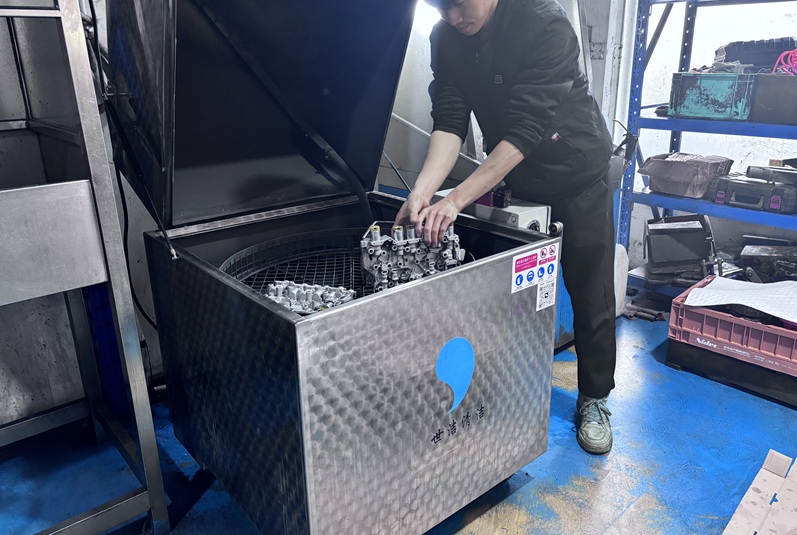
We are a parts supplier, not a marketing department, so here is the process in the order it happens, with the reject criteria attached. Every step has a failure mode it is designed to catch; a process without reject criteria is a cleaning service.
| Step | What is done | What gets rejected |
|---|---|---|
| 1. Core acceptance | Version identified from the number, cap type and casting; core inspected for cracks and heat damage | Wrong family (for example a six-solenoid 31705-50X0B unit), cracked casting, fire damage |
| 2. Teardown and clean | Full disassembly to bare casting and valves; multi-stage ultrasonic cleaning; every passage brushed and blown | Bodies with corrosion pitting in a bore, or with a passage that will not clear |
| 3. Dimensional and vacuum check | Bore measurement plus vacuum test on each regulator circuit | Any circuit that will not hold vacuum after cleaning |
| 4. Bore reconditioning | Where wear is found, the bore is reamed and an oversized regulator valve fitted with the OE spring | Bodies where the wear is beyond the oversize range of the available valve |
| 5. Valve and spring audit | Every spool checked for scoring and stick-slip; springs checked for free length and rate | Scored spools, springs out of spec, mismatched spring sets from mixed cores |
| 6. Solenoid and sensor test | Resistance logged at 20 °C and at operating temperature; actuation and leak check; sensor voltage logged | Any coil outside the temperature window, any solenoid that leaks or sticks when hot |
| 7. Assembly and calibration | OE gaskets and seals, correct separator plate, calibration loaded and verified against the memory device | Units where the calibration will not load or does not match the version |
| 8. Flow and pressure test | Line pressure checked against the published values at idle in P/N, at idle in D/R and at stall; leak-down logged | Units outside the acceptance band, or with pressure decay across the test window |
The pressure and acceptance numbers behind step 8 are published in full, with the test conditions they are only valid under, in the bench-test procedure article. We would rather you checked our units against the same numbers we do.
09Five questions that make two offers comparable
You do not need to compare anything else to find out whether two valve bodies are the same product. Ask these five, in writing, and read the answers for what they do not say.
| Question | What a process-based answer sounds like | What a repackaged unit sounds like |
|---|---|---|
| 1. Are the bores measured or just cleaned? | Named circuits, a vacuum figure, and what happens when a circuit fails | "Fully tested", "100% quality" |
| 2. Are the solenoids tested hot as well as cold? | A temperature window and the resistance range by temperature | "Solenoids checked" |
| 3. What calibration goes in, and what must the installer do after? | A named initialization sequence and a warning about adaptive learning | "Plug and play" |
| 4. Which version is this unit, and how did you confirm it? | The number, the cap type, the market stream, and the housing stamp | "Fits all JF015E" |
| 5. What exactly does the warranty cover, and for how long in writing? | A period, what is inside it, and the labour position | "Guaranteed", with nothing on paper |
An offer that answers all five is comparable to ours on the only axis that matters. An offer that answers none of them is a casting in a box, and the fact that it works for a while is not evidence that it was remanufactured — it is evidence that the wear had not yet reached the point where the driver notices.
10How to order the right one the first time
We do not confirm a JF015E valve body from a part number alone, because the number identifies the version and the housing identifies the car. Send the following and the confirmation comes back in writing within four business hours, with the version, the calibration stream and what the installer has to do:
- Housing stamp code from the transmission case — the single most useful item.
- VIN, which settles build market and engine.
- A photograph of the original valve body from the solenoid side — cap type and connector body.
- Stored and pending fault codes, before anything is cleared.
- Fluid condition, with a photograph of the pan magnets if the pan is already off.
- What the car actually does — cold, hot, light throttle, under load.
Minimum order is one piece. Every valve body we ship is flow- and pressure-tested on a computerised bench, comes with a 12-month written warranty, and is matched to your code rather than to a vehicle year chart. If the honest answer is that you need an assembly rather than a valve body, we will say so, because a comeback is worse for both of us than a missing order.
Valve-level wear behaviour, circuit relationships and the fact that the secondary pulley circuit doubles as main line pressure are taken from Sonnax technical material for the JF015E (RE0F11A) valve body, including the oversized secondary pulley/pressure regulator valve kit 33741F-01K, the oversized primary pulley regulator valve kit 33741F-02K and the oversized solenoid regulator valve kit listed for this unit. Solenoid resistance windows by temperature, sensor values, fluid capacity and the valve body removal notes used elsewhere on this page come from the ATSG CVT 7 JF015E / RE0F11A / F1CJB technical service information (2015). The definitions of remanufactured, rebuilt and new follow the process distinctions used by the North American remanufacturing trade and by independent aftermarket explainers; the calibration-by-VIN practice in the US reman market is described as those suppliers present it. Aftermarket install guidance is cited only where it is labelled as such. Nothing here replaces the code stamped on your own transmission housing or the service data for your model year.
11Sources and frequently asked questions
Is a remanufactured JF015E valve body as good as new?
Functionally it can be, and on this platform it often is the better choice, because a remanufactured unit keeps the OE casting and OE solenoids while correcting the specific bores that wear. What it is not is automatically equivalent: the outcome depends entirely on whether the bores were measured and reconditioned and whether the solenoids were tested at operating temperature. A new unit removes the wear question but introduces a supply and supersession question, and an aftermarket new unit introduces a casting and solenoid-source question.
Can I fit a used valve body and hope for the best?
You can, and sometimes it works — particularly as a diagnostic substitution to prove the fault is hydraulic. Before fitting one, check solenoid resistance cold and hot, vacuum-test each regulator circuit, inspect the casting face and gasket tracks, cut the filter, and confirm the version including the solenoid cap type. If any of those checks fails, the unit is not a gamble worth taking, because the labour to change it twice is the largest single item in the job.
Why do some sellers charge extra for calibration matching by VIN?
Because the calibration data lives in a memory device inside the control valve assembly, and a generic reference calibration relies on the TCM's adaptive learning to close the gap. That usually works in the original market. It works less well across market streams or when the TCM has already adapted to a worn unit. Suppliers who include matching, rather than selling it as an option, are telling you something about how they build the unit.
Do all JF015E valve bodies have the same solenoids?
No. The family runs to five control solenoids with specific normally-high and normally-low assignments, and the solenoid cap type changed during production — open versus closed. Upgrading a closed-cap position to an open-cap solenoid is an accepted service change; fitting a closed-cap solenoid where an open-cap one belongs is not, because it reintroduces the heat failure the change was made to remove. This is one reason we ask for a photograph of the solenoid side.
What does "rebuilt" mean if there is no standard?
Exactly what the seller decides it means. It may describe a disciplined specialist process identical to remanufacturing, or it may describe cleaning, new seals and a coat of paint. Because there is no documentation requirement, you cannot tell from the label. On a platform where bore wear is the dominant failure, that ambiguity is the whole problem, so treat the word as a question rather than as a specification.
How long should a valve body last after replacement?
As long as the rest of the transmission allows. If the belt and cone faces are sound, the cooler circuit is flushed and the correct NS-3 fluid is used at the correct level, a properly reconditioned valve body is not the weak point. If belt debris is still circulating, no valve body will last, which is why we ask for fluid condition before confirming a unit. Our written warranty runs 12 months.
Can a valve body failure damage the belt?
Yes, and this is the most common way a valve body job becomes an assembly job. When secondary pulley pressure control is lost, clamp force falls, the belt slips on the cones, and the resulting heat and fretting contaminate the fluid — which then damages the next valve body. That loop is why we treat "valve body only" as a diagnosis to be confirmed, not a default.
How do I get a JF015E valve body confirmed for my car?
Send the transmission housing stamp code, the VIN, a photograph of the original valve body from the solenoid side, the stored fault codes and the fluid condition. We confirm the version, the calibration stream, availability and lead time in writing within four business hours. Minimum order is one piece, every unit is bench-tested before dispatch, and the warranty is 12 months in writing.