
On this page
- What a nameplate photo can and cannot prove
- The four different marks people call a “nameplate”
- Where the marks actually sit on a JF015E
- The five-photo set we ask for
- How to make a label readable in one shot
- The stamp code is the index this family actually uses
- Why the QR label matters more on a valve body than on an assembly
- What the VIN proves, and the one thing it cannot
- The message that gets a same-day answer
- When the label is gone, painted over, or belongs to someone else's repair
- Six mistakes that turn a photo into a wrong order
- Privacy
- Sources and frequently asked questions
3JX4E, 3JX6C, X427E, X428E). Send those two shots square-on and in focus, plus one wide shot of the whole unit, the model year and market, the VIN, and the stored fault codes. That is enough for us to name the valve body version in writing. A single photo of a grimy sticker, or a screenshot of a marketplace listing, is not.Most wrong-part claims in this trade do not start with a dishonest seller. They start with a photograph that looked convincing on a phone screen: a sticker read at an angle, half of it in shadow, with the last four characters cut off by the crop. The buyer believed the photo. The seller believed the buyer. The part that arrived was for a different build. This page is the exact photo set we ask for at the bench, why each shot exists, and what each one can and cannot prove — so the confirmation happens once, before anything ships.
What this page gives you
- The four different marks people call a “nameplate”, and which one actually decides the part.
- The five-photo set that replaces twenty messages — framing, distance and lighting for each.
- The stamp-code index for this family, including the wide-ratio code that is not a JF015E at all.
- Why the QR label matters more on a valve body than on a complete assembly, and the number-matching rule behind it.
- What to send when the label is gone, painted over, or belongs to a unit another shop already replaced.
01What a nameplate photo can and cannot prove
A photograph is evidence, and like any evidence it has a strength. Used at the right strength, it closes a fitment question in one exchange. Used beyond its strength, it manufactures confidence that the part will fit when it will not.
Here is the honest boundary. A clear label photo can prove which unit is physically in front of the camera — its build reference, its market stream, its calibration family. It cannot prove that the unit belongs to the car in the VIN, because transmissions get swapped. It cannot prove the internal condition, because a label survives a failed belt. And it cannot prove interchangeability with a different part number, because interchange is a specification question, not a photographic one.
So we use the photo for what it is good at: identity. Condition comes from the bench. Interchange comes from the part number. The vehicle comes from the VIN and the build label. When all four agree, the order is boring and correct, which is the goal.
| What you send | What it genuinely proves | What it does not prove |
|---|---|---|
| A label or QR photo, in focus | Which build of unit is on the bench right now | That the unit is the one the car left the factory with |
| A case or pan stamp photo | Which stamp group the housing belongs to | Which valve body or calibration is inside it today |
| The VIN | The original vehicle configuration, via build data | What has been fitted since — including a replacement transmission |
| Stored fault codes | Which hydraulic or electrical circuit is complaining | Whether the cause is the valve body, the belt, or a sensor |
| A marketplace listing title | That someone typed those words | Anything at all about your unit |
02The four different marks people call a “nameplate”
When a buyer writes “I will send the nameplate photo”, they usually mean one of four things, and the four carry completely different information. Naming them separately is the fastest way to stop the confusion, because half of all misfit conversations are two people talking about different marks.
| Mark | What it usually looks like | What it typically carries | What it decides |
|---|---|---|---|
| Unit identification label | Printed sticker, sometimes a small metal plate, on the case | Model or family code, OEM part number, serial, build date, plant | The build reference of the unit — the strongest single item you can photograph |
| QR / data-matrix label | Small square code, often beside or on the label | A machine-readable build and calibration reference | Ties the unit to a calibration file — decisive when ordering a valve body |
| Housing or pan stamp | Characters cast or stamped into metal, no sticker | A short alphanumeric group such as 3JX6C or X428E | Which stamp group the housing belongs to — survives cleaning, paint and time |
| Vehicle labels | VIN plate, door-jamb build label, underhood fluid label | VIN, build date, market, fluid specification | The car's original configuration and the fluid grade it was built for |
The practical rule: the label identifies the unit, the stamp identifies the housing, the VIN identifies the car. Fitment confirmation needs the first two. The third tells us whether the question is even about the original unit.
A listing screenshot proves that a seller typed a part number next to a photo. It does not prove the number is on your transmission. We have seen the same photographed valve body reused across four different listings with four different interchange claims. A thirty-second photo of your own housing outranks any listing, including ours.
03Where the marks actually sit on a JF015E
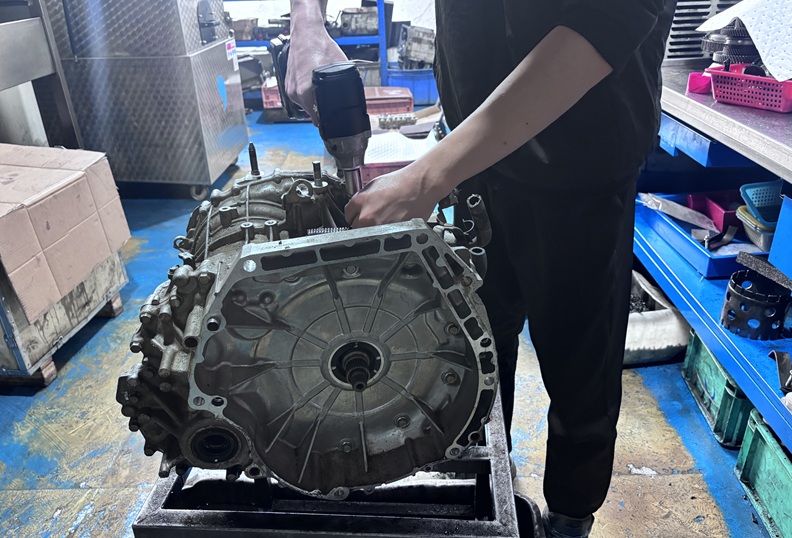
Positions vary by build and by plant, so treat the table below as a search route rather than a guarantee. What is consistent is the principle: the label lives where a technician can reach it with the unit in the car, which means the upper case, the converter housing side, or beside the range switch — not underneath, and not behind the engine block.
| Place to look | What you are looking for | How to shoot it |
|---|---|---|
| Top of the case, near the bellhousing flange | Printed label or stamped characters on the upper surface | From above, square-on, with the camera parallel to the surface |
| Side of the main case above the oil pan rail | Sticker, metal plate, or a QR label | From the side, raking light across the surface to lift the characters |
| Beside the transmission range switch | QR or data-matrix label on many Nissan CVTs | Close, focused on the code, with the connector in frame for context |
| Oil pan surface | Stamped group code, often the same characters as the case | Straight down on the pan, light at a low angle |
| Converter housing / front face | Cast marks, occasionally a plate | Wide shot of the whole front face, then a close crop |
| Door jamb of the vehicle | Build label with VIN, build date and market | Flat, straight-on, all four corners visible |
If you cannot find a label within two minutes, stop looking and shoot the four sides of the unit plus the pan. Every confirmation we have done on a label-less unit was solved by wide shots, not by a better close-up of the wrong area.
04The five-photo set we ask for
Five shots, taken once, end the conversation. Each one answers a different question, which is why five is the number rather than one perfect close-up.
| # | Shot | Framing | What it rules out |
|---|---|---|---|
| 01 | Wide three-quarter view of the whole unit | Whole case in frame, converter side and one long side visible | Wrong family entirely — a CVT8 or a wide-ratio CVT7 looks different in silhouette |
| 02 | Identification label, square-on | Label fills the frame with a 5 mm margin of surrounding metal | Truncated part numbers and misread suffix letters |
| 03 | QR or data-matrix label, close | Code centred, quiet zone visible on all four sides | Calibration mismatch on a valve body order |
| 04 | Case or pan stamp, raking light | Light from the side at roughly 30–45°, camera perpendicular | Confusion between adjacent characters — the classic 6/8, 5/S, 0/O |
| 05 | The failed part itself, or the pan with its fluid | Part on a clean surface, pan tilted to show the fluid and any debris | Ordering a valve body for a belt failure, or the reverse |
Shot 05 is the one buyers skip, and it is the one that changes orders. A pan with grey paste and a clean belt points at the valve body. A pan with bright flakes and a scored cone points at the pulley and belt set, where a new valve body will simply fail again. Send the fluid, even if it looks unremarkable.
05How to make a label readable in one shot
Almost every unreadable label photo fails for one of five reasons, and all five are fixable with a phone and thirty seconds.
- Glare. Direct flash on a glossy sticker turns the middle characters into a white bar. Move into shade, or put a sheet of white paper between the light and the label to diffuse it.
- Angle. Shooting from 45° compresses the far end of the label. Hold the phone parallel to the label surface, even if that means crouching under the car.
- Distance. A label photographed from a metre away has about forty pixels of character height. Get to 15–20 cm and let the phone switch to its macro or 2× lens.
- Grime. A dry rag first, then a rag dampened with cleaner — never spray solvent onto a label or into the case. Let it dry before shooting; wet labels reflect.
- Compression. This is the one nobody expects. Chat apps resample photos to save data, and a label that was just readable becomes mush. Send the image as a file or document, not as a chat photo, or email the original.
| What the photo looks like | Likely cause | The fix |
|---|---|---|
| White blowout across the middle of the sticker | Direct flash or a work lamp head-on | Diffuse the light, shoot in shade, angle the lamp away from the camera axis |
| Sharp at one end, soft at the other | Camera not parallel to the surface | Square the phone to the label; take a second shot rotated 90° |
| Characters legible but cut off at the edge | Cropping too tight in the phone | Leave a margin of surrounding metal on all four sides |
| Stamp reads as smeared shadow | Light straight down the camera axis | Move the light to the side until the characters cast a short shadow |
| Perfectly readable on your phone, unreadable on ours | Chat-app compression | Send as a document/file, or email the original file |
| Label is clean but blank where the number should be | Heat, solvent or pressure washing has taken the print off | Fall back to the stamp and the wide shots — see section 10 |
06The stamp code is the index this family actually uses
Nissan part numbers describe the part. Stamp codes describe the build group, and for the CVT7 family the build group is what separates two units that look identical on a pallet. One widely used aftermarket CVT catalogue indexes this entire family by stamp code rather than by model year, which tells you something about how the trade really identifies these units.
| Stamp code | Family | Applications in that index | What it tells us |
|---|---|---|---|
3JX4E | RE0F11A / JF015E | 2012 Versa 1.6L, 2WD | Earliest US-stream stamp group in that index |
3JX6C, X425A, X424C | RE0F11A / JF015E | 2013–2019 Versa 1.6L; 2014–2019 Versa Note 1.6L, 2WD | The mainstream JF015E group — several codes sharing one application band |
X427E, X427A, X428E | RE0F11A / JF015E | 2013–2018 Sentra 1.8L, 2WD | The 1.8L stamp group, distinct from the 1.6L group |
X428D, X428E | RE0F11A / JF015E | 2016–2018 Sentra 1.8L, 2WD | Later 1.8L build; note X428E appears in both bands |
50X1A, 50X5A | RE0F11A / JF020E | 2018–2019 Kicks 1.6L, 2WD | Not a JF015E. Same catalogue family heading, wide-ratio transmission, different everything inside |
Two cautions that matter more than the table. First, one stamp code can carry more than one application, and one application band can span several stamp codes — X428E appears in two overlapping bands above. Second, the stamp identifies the housing group, not the calibration of the valve body bolted to it, which is why a stamp photo alone will not settle a valve body order. It narrows the shelf; the label and QR pick the row.
These units sit under the same catalogue heading as the JF015E and fit some of the same cars — the 2018–2019 Kicks being the usual example. They are RE0F11B / JF020E wide-ratio units with a six-solenoid valve body. Nothing from the JF015E valve body shelf fits them. If your stamp starts with 50, say so in the first message; it saves an entire exchange.
07Why the QR label matters more on a valve body than on an assembly
A complete transmission can often be confirmed from the label and the stamp. A valve body cannot, because the valve body carries a calibration, and calibration is the one property that no external stamp describes.
Nissan's own service procedure for CVT calibration data makes the point explicitly. When a valve body is replaced, three numbers must agree before the data is written: the number on the calibration file supplied with the new valve body, the number on the QR label supplied with it, and the calibration file number on the valve body itself. The bulletin states that all three must be the same. The same procedure requires calibration data to be erased and written, followed by clutch point learning and select learning.
| Item that must agree | Where it lives | Why a photo matters |
|---|---|---|
| Calibration file reference | Supplied with the replacement valve body | Establishes which calibration the replacement was built to |
| QR label reference | On or with the valve body; on a complete CVT, the bulletin's example places it at the range switch | The only machine-readable link between the metal and the file |
| Number on the unit itself | Case or body surface | Proves the QR label belongs to this body rather than a box |
| Original unit's label | On the valve body you are replacing | Lets us match the replacement version to the build it came out of, not to a year chart |
One honest limitation: that bulletin is written for the vehicles in its own applied-vehicle list, not for every JATCO CVT ever built. We cite it because it defines the matching discipline, not because it is the JF015E procedure. On the JF015E the calibration lives in a ROM assembly inside the control valve and is handled through the scan tool rather than a disc — the sequence is covered in our programming and relearn guide. The photographic requirement is identical either way: photograph the QR label on the part you are replacing, and photograph the QR label on the part that arrives. If the two references do not correspond to the same build, stop before installation, not after.
08What the VIN proves, and the one thing it cannot
Buyers often send a VIN instead of a photo, expecting it to settle everything. It settles less than they think, and it is still worth sending.
A VIN identifies the original vehicle configuration: model, engine, market, plant, build sequence. Decoded against manufacturer build data, it tells us which transmission the car was built with. What it does not do is describe the metal currently bolted to the engine, because transmissions get replaced — sometimes twice, sometimes with a unit from another market.
One common myth is worth correcting here: the eighth character of a VIN is the engine code, not a transmission code. Transmission identity comes from the combination of build data, not from a single character. Anyone who tells you to read the transmission off the eighth digit is guessing.
| Evidence | Answers | Cannot answer |
|---|---|---|
| VIN alone | What the car was built with | What is in it now |
| VIN + door-jamb build label | Build date and market, which narrow the calibration window | Whether the unit has been swapped |
| VIN + label photo from the unit | Whether the unit matches the car's original build | Internal condition |
| VIN + label + stamp + fault codes | Nearly everything needed to confirm a part in writing | Whether the belt and cones are also worn — that is a bench question |
If the car has clearly been apart before — fresh sealant, mismatched fasteners, a rebuild tag on the case — say so. A mismatched unit is not a problem for us. A mismatched unit presented as original is how a correct part gets returned.
09The message that gets a same-day answer
Photographs without context still leave a round trip. Nine lines of text, sent with the five shots, is the difference between one reply and four.
| Field | Example of a usable answer | Why we need it |
|---|---|---|
| Vehicle | 2016 Nissan Versa Note 1.6L, FWD, US market | Places the unit in an application band |
| VIN | Full 17 characters, or the first 11 if your policy requires | Confirms original build configuration |
| Stamp code | 3JX6C, read off the pan | Identifies the housing group |
| Label / QR reference | Whatever the sticker and the QR carry | Identifies the build and calibration |
| What failed | Judder under light throttle, P0841 stored, pan fluid grey | Points at the circuit, not just the family |
| Stored codes | Full list, including pending and history | Separates hydraulic from electrical |
| What you want to order | Valve body only, or valve body with gasket and filter | Decides whether you need 31705 or the 3170E kit |
| Quantity and destination | 2 units, Lagos, Nigeria | Stock and freight routing |
| Deadline | Vehicle promised to the customer Friday | Lets us tell you honestly whether the date is achievable |
Send it on WhatsApp with the photos attached as files, or through the form on the contact page. Both reach the same engineering inbox, and both get an answer in writing within four business hours — not a catalogue number, a part confirmation: the version, the number, and the stock position.
10When the label is gone, painted over, or belongs to someone else's repair
Label-less units are normal in this trade, not exceptional. Here is what we work from instead.
| Situation | What to shoot instead | What we can still confirm | What we cannot |
|---|---|---|---|
| Sticker washed off by a pressure washer | All four sides wide, plus the pan stamp | Family and housing group with high confidence | The exact calibration lineage |
| Case painted or chemically cleaned | Raking-light shots of the stamp, plus the pan | Housing group, where the stamp survives | Anything printed — paint removes print first |
| Rebuild tag riveted on by another shop | The aftermarket tag, the original stamp, and the valve body label | Which version the rebuilder used | Whether the rebuilder's calibration matches the car |
| JDM unit in a US-market car | Label, stamp, and a wide shot showing connectors and cooler fittings | The unit's own identity | That its calibration suits the car's emissions and shift strategy |
| Another shop already replaced the valve body | The current valve body's label, not the transmission label | The version now fitted | The original build — unless the VIN decode supplies it |
| Complete unknown, bought at auction | Every mark you can find, plus pan fluid | A shortlist, never a single answer | Anything that requires the original number |
In all six cases the honest outcome is a range, not a promise: “this is a JF015E housing from the 3JX6C group; the valve body version needs the label off the body itself.” We would rather send that sentence than a confident part number built on a painted case.
11Six mistakes that turn a photo into a wrong order
- Photographing the listing instead of the part. The listing describes what the seller has. Only your housing describes what you need.
- Sending the label but not the stamp. The label gives the build reference; the stamp gives the group that the parts shelf is actually organised by. Half of the evidence produces half an answer.
- Cropping to the number. The market suffix and the last character live at the edge of the sticker. A tight crop is how
X429BbecomesX429. - Sending a chat-compressed photo. If the characters are only just readable on your screen, they are gone by the time they arrive.
- Describing the car instead of the unit. “2016 Versa” is a starting point. Two cars of the same year and badge can carry different builds, and one of them may have been swapped.
- Ordering a valve body for a belt failure. The photograph that prevents this is shot 05 — the pan and its fluid. Grey paste and a clean belt is a valve body conversation; bright flakes and a scored cone is not.
The pattern behind all six is the same: the photo is used to end the conversation early instead of to answer the question properly. A correct confirmation takes one extra shot and ninety seconds.
12Privacy: what to blur, what to keep
A VIN is vehicle identity, and a workshop's job card often carries the owner's name and address in the same frame. Neither is needed for a fitment confirmation.
- Blur or crop: the customer's name, address, phone number, job-card number, and the licence plate. None of it changes the part.
- Keep visible: the label, the QR code, the stamp, the VIN's first eleven characters, and any rebuild tag. These are the evidence.
- Do not photograph a customer's vehicle documents, service history, or anything showing a third party's personal details.
On our side, photos stay attached to the order record so the confirmation can be checked if a question comes up months later. We do not publish a customer's photographs, a customer's name, or a customer's country alongside a part unless we have asked first — the same rule we apply to the crate labels we blur in our own factory photographs.
13Sources and frequently asked questions
Everything above is either a physical property of the unit or a published procedure. The stamp-code groupings come from an aftermarket CVT catalogue that indexes this family by stamp code; the calibration-matching discipline comes from Nissan's published CVT calibration data procedure; the traceability QR practice is described in JATCO's own plant reporting. Where a source covers a different model line than the JF015E, we say so rather than borrowing its authority.
Can you confirm a JF015E valve body from one photo of the sticker?
Usually not, and we will tell you when it is not enough rather than guess. One sticker identifies the transmission build; a valve body order also needs the label or QR reference on the valve body itself, because the calibration lives there. Send the sticker, the QR if there is one, and the pan stamp, and the answer becomes definitive.
Where exactly is the nameplate on a JF015E?
It varies by build and plant, so there is no single answer we would stake an order on. Look on the upper case near the bellhousing flange, on the side of the main case above the oil pan rail, and beside the range switch. If two minutes of looking finds nothing, shoot the four sides and the pan — we can work from that.
My label is painted over. Is the unit unusable for identification?
No. The stamp code on the case or pan usually survives paint, and it places the housing in a group. What you lose is the calibration lineage, so for a valve body we would confirm the housing group and ask for the label off the valve body you are replacing. If that is also gone, expect a range rather than a single part number.
Why do you ask for the fault codes as well as the photos?
Because identity and failure are different questions. Photos tell us which unit you have; codes tell us which circuit is complaining. A P0841 with grey pan fluid points at the secondary pressure circuit; the same code with bright flakes points at a belt on its way out. Ordering the right part for the wrong failure is the most expensive mistake in this trade.
Is a VIN enough to identify the transmission?
It identifies what the car was built with, decoded against manufacturer build data. It does not describe what is bolted in today, and the eighth character is the engine code, not a transmission code — that is a common myth worth discarding. Send the VIN, but send the photo too.
What if the stamp starts with 50?
Then you very likely have an RE0F11B / JF020E wide-ratio unit, not a JF015E — the 2018–2019 Kicks is the usual example. It shares a catalogue heading with the JF015E and fits some of the same cars, but its six-solenoid valve body and its internal parts do not interchange. Say so in your first message and we will point you to the correct shelf.
How should I send the photos so they stay readable?
Send them as files or documents rather than chat photos, or email the originals. Chat apps resample images and a label that was readable on your phone can arrive as mush. One photo per message also helps, because some apps recompress the whole batch.
How fast do you answer, and what does the answer contain?
Within four business hours. The reply names the version and part number we would supply, confirms stock, and states the lead time in writing. If the evidence supports two possible versions, the reply says so and tells you which extra photo settles it. We do not send a part number we cannot stand behind.